


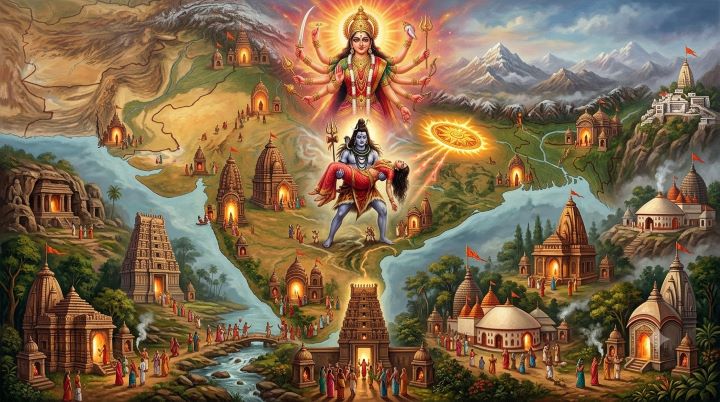
Shakti Pithas are among the most sacred pilgrimage destinations in Hinduism, attracting devotees from across the world. These holy sites are believed to be the places where Maa Sati’s body parts, ornaments, or sacred forms fell after her self-sacrifice, making each location a powerful center of Divine Shakti. Every Shakti Pitha has its own unique form of the Goddess, a corresponding Bhairava (Lord Shiva), and centuries-old traditions of worship.
Understanding how these sacred places came into existence helps reveal why they continue to hold such immense spiritual significance for millions of devotees.
How Were Shakti Pithas Created?
The origin of the Shakti Pithas begins with the famous story of Daksha’s Yajna. When King Daksha insulted Lord Shiva, his daughter Maa Sati could not bear the disrespect shown to her husband and immolated herself in the sacrificial fire. Devastated by her death, Lord Shiva carried her body across the universe in deep sorrow, causing cosmic imbalance.
To restore harmony, Lord Vishnu used his Sudarshana Chakra to gently separate Maa Sati’s body. Wherever her body parts, ornaments, or sacred symbols fell, those places became known as Shakti Pithas, each becoming a powerful center of Goddess worship.
Which Places Became the Shakti Pithas?
According to different Hindu traditions, every Shakti Pitha is associated with a body part or ornament of Maa Sati. While the exact associations vary across scriptures, some of the most widely accepted Shakti Pithas include:

Shakti Pitha Location Associated Body Part
| Shakti Peetha | Location | Associated Body Part |
|---|---|---|
| Kamakhya | Assam | Yoni |
| Kalighat | Kolkata, West Bengal | Toes |
| Jwala Devi | Himachal Pradesh | Tongue |
| Vishalakshi | Varanasi | Face or Earrings |
| Ambaji | Gujarat | Heart |
| Taratarini | Odisha | Breasts |
| Amarnath | Jammu & Kashmir | Throat |
| Lalita Devi | Prayagraj | Fingers |
| Mahishasuramardini | Kolhapur | Third Eye |
| Bhramari | Nashik | Chin |
| Gayatri | Pushkar | Wrist |
| Sravani | Kanyakumari | Back and Spine |
| Bhramaramba | Srisailam | Right Anklet |
| Narayani | Kanyakumari | Upper Teeth |
| Hinglaj Mata | Balochistan, Pakistan | Traditionally associated with the head; varies by tradition |
| Bimala Temple | Puri, Odisha | Sacred association varies by tradition |
| Biraja Temple | Odisha | Regional association varies |
| Tripura Sundari | Tripura | One of the revered Shakti Pithas; traditions vary |
How Did Shakti Pithas Become Sacred Temples?
Unlike ordinary temples that were built during a single historical period, Shakti Pithas became sacred because of their connection to Maa Sati.
Many of these places were already ancient centers of Goddess worship, and later Puranic and Tantric traditions identified them as the places where Maa Sati’s divine body fell.
Over centuries, people built magnificent temples, turning these holy sites into major pilgrimage destinations across India and neighboring regions.
Why Do Different Scriptures Mention Different Numbers of Shakti Pithas?
One of the most common questions is why some texts mention 18, while others speak of 51, 52, 64, or even 108 Shakti Pithas. Different Puranas, Tantric traditions, and regional lineages preserve their own sacred lists. Some traditions associate a site with a body part, while others link it with an ornament or another sacred symbol of Maa Sati. These variations reflect the richness of Hindu tradition rather than contradictions.

Every Shakti Pitha is also traditionally associated with:
- A unique form of Maa Shakti.
- A corresponding Bhairava, a form of Lord Shiva.
- Regional festivals, rituals, and centuries-old devotional practices.
The Spiritual Significance of Shakti Pithas
Shakti Pithas are more than pilgrimage destinations. They symbolize the presence of the Divine Mother’s power throughout the land. Each shrine represents a unique manifestation of Shakti, and together they form a sacred spiritual map that connects mythology, devotion, pilgrimage, and the eternal bond between Maa Sati and Lord Shiva. Visiting these holy places is believed to inspire faith, inner strength, and a deeper connection with the Divine Mother.
Visit a Shakti Pitha with sincere devotion to seek Maa Shakti’s blessings and experience the spiritual power of these sacred pilgrimage sites.
Feature Image Credit: AI-generated image created with Google Gemini, September 27, 2026.