


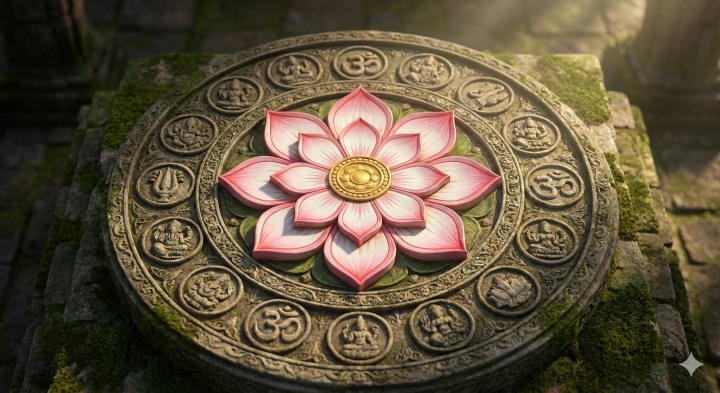
The Ashtadal lotus, or eight-petalled lotus, is one of the most powerful and universal symbols in Hindu and Buddhist traditions. It represents purity, awakening, and the expansion of consciousness in all eight directions. Because each petal radiates from a central point, the Ashtadal lotus is seen as a map of the heart, the mind, and the entire cosmos.
Spiritual Significance
“Ashta” means eight, and “dal” means petal. The eight petals signify completeness, harmony, and the unfolding of inner potential. The lotus itself grows from mud yet remains untouched, symbolising detachment and inner purity. When visualized in meditation, the Ashtadal lotus represents a heart that has fully bloomed while staying rooted in clarity and truth.
Mythological Connections
Many deities in Hindu and Buddhist lore are connected to the eight-petalled lotus. Lakshmi, Saraswati, Vishnu, and several forms of Shakti are depicted seated on an Ashtadal lotus, representing prosperity, knowledge, and divine order.
In the creation story, the lotus emerging from Lord Vishnu’s navel—on which Brahma sits—is often interpreted as a cosmic Ashtadal padma, the blueprint of creation itself.
In Buddhist iconography, the Buddha and Bodhisattvas are shown seated on an eight-petalled lotus, each petal representing virtues that lead to enlightenment.

Uses in Worship and Daily Practice
Ashtadal motifs appear in yantras, mandalas, rangoli, kolam, and deity pedestals. In puja rooms, placing an Ashtadal pattern beneath Lakshmi or Vishnu murtis is believed to invite purity and prosperity. The eight-petalled ring in yantras acts as the meditation seat where the deity is visualised.
Benefits and Practical Significance
The Ashtadal lotus is believed to
- Bring harmony across all eight directions
- Support concentration and deep meditation
- Encourage emotional healing and mental balance
- Attract prosperity, purity, and auspicious energy
- Help create a sattvic, peaceful spiritual atmosphere
- Strengthen inner qualities like compassion, courage, clarity, and devotion
- Enhance Vastu alignment in puja rooms or sacred spaces
- Offer symbolic protection and spiritual grounding

Many practitioners meditate on its eight qualities—compassion, courage, wisdom, devotion, clarity, detachment, humility, and balance—to support emotional healing and inner stability.
The Ashtadal lotus is a reminder that inner growth is possible for anyone who chooses to stay balanced, pure in intention, and open to light.
Image Credit: AI-generated image created with Google Gemini, December 24, 2025.