


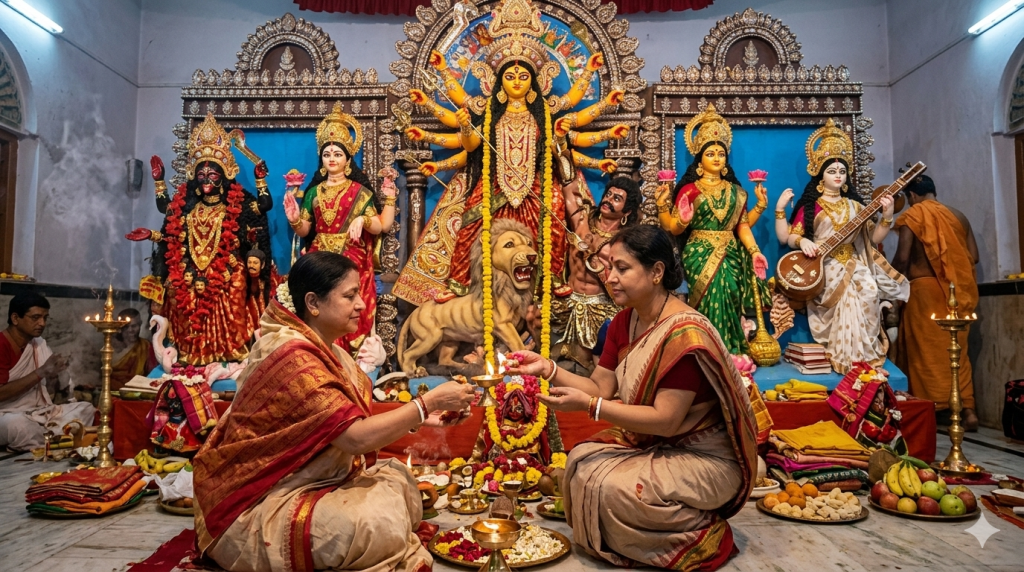
Shakta worship is one of the most ancient and profound spiritual traditions within Hindu mythology. It centers on Shakti, the Divine Mother, not as a supporting force but as the supreme reality itself.
In Shaktism, the universe moves, transforms, and renews through feminine power. Shiva represents pure consciousness, but without Shakti, he is described in scriptures as inert. This vision places the feminine at the very heart of creation.
What Is Shakta Worship?
Shakta worship is the devotion to Devi in her many forms, such as Durga, Kali, Lalita Tripura Sundari, Lakshmi, and Saraswati. These forms are not separate goddesses but expressions of one Adi Parashakti, the primordial cosmic energy. This tradition draws from the Devi Mahatmya, Tantras, Puranas, and even older folk and tribal traditions that revered the Mother as fertility, earth, and protector long before formal temples existed.

Unlike purely ascetic paths, Shaktism accepts life in its fullness. Birth, desire, struggle, power, and death are all seen as sacred expressions of the Mother.
Mythological and Spiritual Significance
In mythology, Devi arises whenever cosmic balance is disturbed. She destroys Mahishasura, Chanda, Munda, and other forces of adharma not out of rage alone, but to restore harmony. These stories symbolically reflect inner battles, where ignorance, fear, and ego are conquered by awakened awareness.
Shakta philosophy teaches that liberation does not come from rejecting the world but from recognizing the Divine within it. Tantra, often misunderstood, is a disciplined spiritual science that uses mantra, yantra, and ritual to awaken dormant Shakti within the human body as kundalini.
Benefits of Shakta Worship
On a spiritual level, Shakta worship builds fearlessness, devotion, and surrender. Chanting texts like the Devi Mahatmya or Lalita Sahasranama purifies karmic impressions and strengthens inner resolve.
For the mind and body, Devi worship is deeply stabilizing. The maternal aspect of Shakti offers emotional healing, courage, and resilience. Many traditions associate Devi sadhana with improved vitality, hormonal balance, and mental clarity, as the nervous system responds to rhythmic chanting and focused ritual.

Materially, Shakti is also the giver of prosperity and protection. Worship is believed to remove obstacles, guard against negative influences, and bless households with abundance.
Practices and Living Tradition
Shakta worship thrives in festivals like Navratri, Durga Puja, Kali Puja, and Ambubachi. Daily practice may include lighting a lamp, chanting a Devi mantra, or offering simple prayers with sincerity. While advanced tantric practices require guidance, household devotion remains accessible to all.
Culturally, Shaktism has empowered communities, preserved indigenous wisdom, and upheld reverence for womanhood as sacred energy rather than weakness.
Worship Shakti to awaken inner strength, protection, and clarity. Begin with devotion and let the Divine Mother guide your transformation.
Feature Image Credit: AI-generated image created with Google Gemini, March 18, 2026