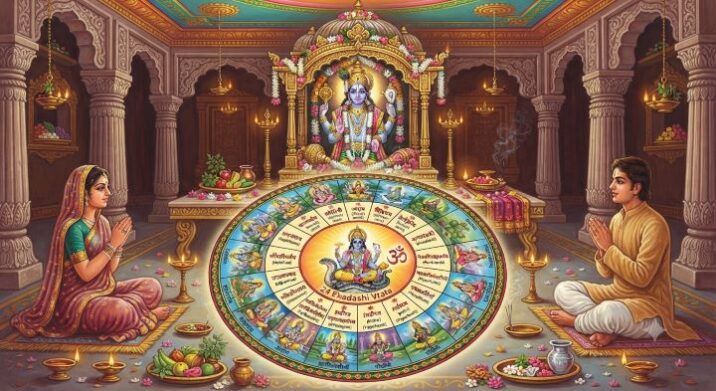
Ekadashi is the 11th lunar day of every Hindu lunar fortnight. It occurs twice each month, once during Shukla Paksha, the waxing moon, and once during Krishna Paksha, the waning moon. A regular lunar year has 24 Ekadashis, while Adhik Maas, the additional lunar month, brings two more: Padmini Ekadashi and Parama Ekadashi.
Every Ekadashi has its own name, traditions, and spiritual significance, but all are especially associated with Lord Vishnu and devotional fasting.
24 Ekadashis and Their Lunar Months
The traditional Vaishnava sequence begins with Margashirsha:
|
Lunar Month |
Krishna Paksha |
Shukla Paksha |
|---|---|---|
|
Margashirsha |
Utpanna |
Mokshada / Vaikuntha* |
|
Pausha |
Saphala |
Putrada |
|
Magha |
Shattila |
Jaya |
|
Phalguna |
Vijaya |
Amalaki |
|
Chaitra |
Papamochani |
Kamada |
|
Vaishakha |
Varuthini |
Mohini |
|
Jyeshtha |
Apara |
Nirjala |
|
Ashadha |
Yogini |
Deva Shayani / Hari Shayani |
|
Shravana |
Kamika |
Putrada |
|
Bhadrapada |
Aja |
Parsva / Parivartani |
|
Ashwin |
Indira |
Rama |
|
Kartika |
Rama |
Haribodhini / Devuthani |
*Vaikuntha Ekadashi is commonly identified with Margashirsha Shukla Mokshada Ekadashi, although in parts of South India the name may refer to Pausha Shukla Ekadashi.
Which Ekadashis Have Special Importance?
Some Ekadashis have particularly distinctive observances. Nirjala Ekadashi is considered among the most austere because devotees traditionally avoid even water. Deva Shayani Ekadashi begins Chaturmas, while Haribodhini or Devuthani Ekadashi marks its conclusion. During these four months, Lord Vishnu is traditionally believed to enter a divine sleep.
Vaikunta Ekadashi is especially important to Vaishnavas because tradition holds that the gates of Vaikunta, Vishnu’s divine abode, open on this day.
What Are the Spiritual Benefits of Ekadashi?
Ekadashi fasting is traditionally observed to support spiritual purification and disciplined living. Devotees believe it can:
- Help purify paap, or accumulated sins.
- Support the pursuit of moksha, or liberation.
- Help fulfill specific desires, as associated with Ekadashis such as Kamada and Putrada.
- Support health, prosperity, and ancestral peace in traditions connected with Yogini and Indira Ekadashi.
- Strengthen devotion, self-control, and spiritual discipline.
How Is an Ekadashi Vrata Observed?
Traditionally, devotees begin their Ekadashi vrat from sunrise on Ekadashi and continue until sunrise on Dwadashi, the following lunar day. The form of fasting varies by Ekadashi, family tradition, and individual capacity. Some devotees consume fruits, milk, or water, while stricter observances may involve complete fasting.
With sincere devotion, choose an Ekadashi you can observe properly and use the day for prayer, self-discipline, and remembrance of Lord Vishnu.
Feature Image Credit: AI-generated image created with Google Gemini, November 27, 2026