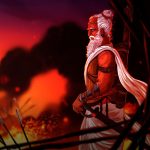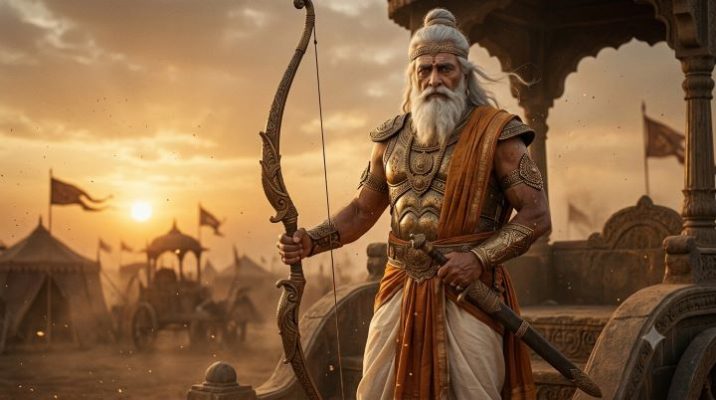
Bhishma Pitamaha is one of the most respected and influential characters in the Mahabharata. Known for his unwavering commitment to duty, extraordinary sacrifice, and unmatched wisdom, his life continues to inspire millions.
Here are 9 fascinating facts that reveal why Bhishma Pitamaha remains one of Hinduism’s greatest heroes.
1. Bhishma Pitamaha Was Born as Devavrata
Before becoming known as Bhishma, his original name was Devavrata. He was the son of King Shantanu and Goddess Ganga, making him a prince blessed with divine heritage and exceptional qualities from birth.
2. Bhishma Took the Legendary Bhishma Pratigya
Devavrata earned the name Bhishma after taking the famous Bhishma Pratigya, a lifelong vow of celibacy and renouncing his claim to the throne. His sacrifice was so extraordinary that the gods themselves praised his determination.
3. Bhishma Sacrificed the Throne for His Father’s Happiness
Bhishma willingly gave up the kingdom so that his father, King Shantanu, could marry Satyavati without any future dispute over succession. His selfless decision became one of the greatest examples of filial devotion in Hindu tradition.
4. Bhishma Was One of the Greatest Warriors in the Mahabharata
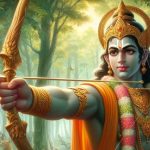
Renowned for his unmatched military skills, Bhishma became the commander of the Kaurava army and led it during the first ten days of the Kurukshetra War. His strength and battlefield wisdom earned the respect of both allies and opponents.
5. Bhishma Was Revered as Pitamah by Both Sides
Although he fought for the Kauravas, both the Pandavas and the Kauravas deeply respected him as their grand-uncle, elder, and guide. This universal respect is why he is remembered as Bhishma Pitamaha, meaning the revered grandfather.
6. Bhishma Was Blessed with Ichha-Mrityu
Because of his extraordinary sacrifice, Bhishma received the divine boon of Ichha-Mrityu, allowing him to choose the exact moment of his death. This rare blessing reflected the immense spiritual merit of his life.
7. Bhishma Rested on a Bed of Arrows
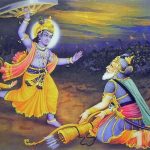
During the Kurukshetra War, Arjun, guided by Lord Krishna, brought Bhishma down with countless arrows. Instead of touching the ground, Bhishma rested on a bed of arrows for nearly 58 days, displaying remarkable endurance and spiritual strength.
8. Bhishma Chose Uttarayana to Leave His Body
Even after being mortally wounded, Bhishma did not give up his life immediately. Using the boon of Ichha-Mrityu, he waited until Uttarayana, the sacred period considered especially auspicious in Hindu tradition, before leaving his earthly body.
9. Bhishma Became One of the Mahabharata’s Greatest Teachers
While lying on the bed of arrows, Bhishma shared profound teachings on dharma, kingship, justice, duty, and righteous leadership with Yudhishthir. These timeless teachings form an important part of the Mahabharata and continue to guide spiritual seekers and leaders alike.
What Bhishma Pitamaha’s Life Teaches Us
Bhishma Pitamaha’s life is a timeless example of duty, sacrifice, discipline, and unwavering commitment to dharma. At the same time, his story reminds us that even the noblest intentions should be guided by righteousness rather than blind loyalty.
Explore the Mahabharata to learn more about Bhishma Pitamaha’s extraordinary life and the timeless wisdom his journey continues to offer.
Feature Image Credit: AI-generated image created with Google Gemini, September 26, 2026